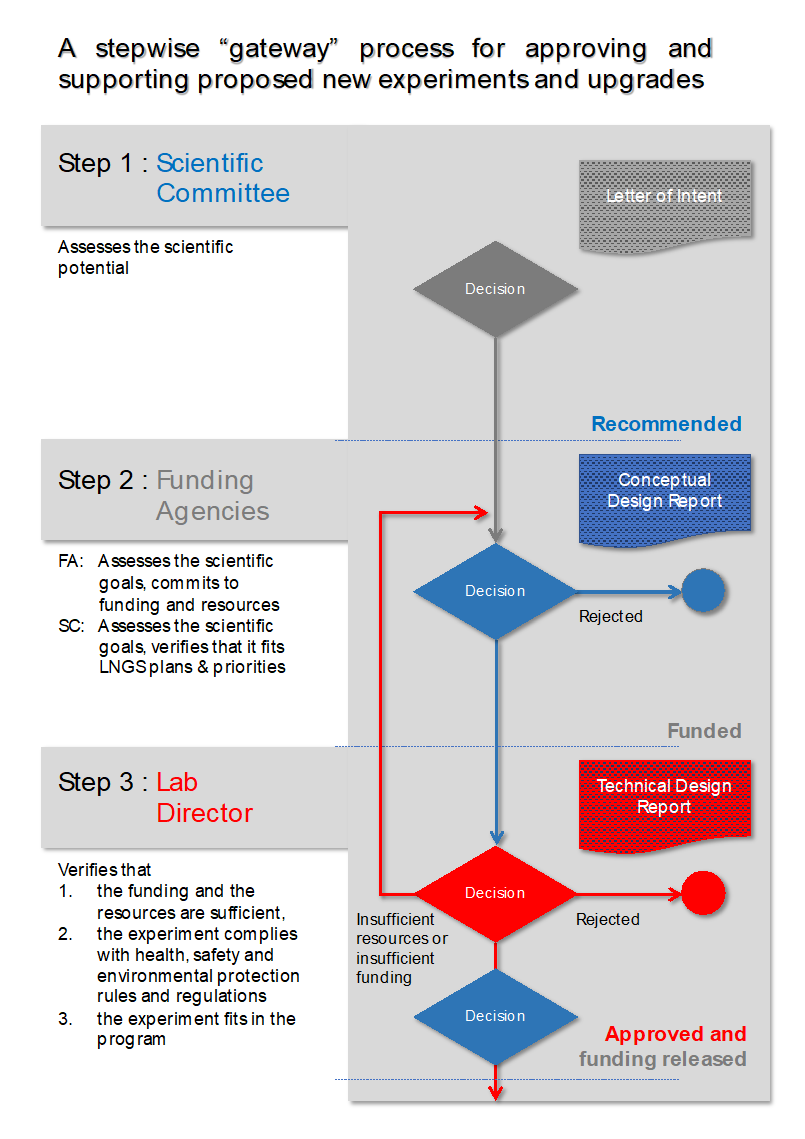
Per proporre un nuovo esperimento ai LNGS, è necessario seguire un processo articolato in tre fasi. La prima fase prevede la presentazione di una “Letter of Intent” (LoI), un documento in cui il gruppo proponente descrive gli obiettivi scientifici, il disegno preliminare dell’esperimento e la fattibilità tecnica. La LoI viene esaminata dal Comitato Scientifico dei LNGS, che valuta il potenziale dell’esperimento e la sua coerenza con la strategia dei laboratori. Se l’esito è positivo, si passa alla seconda fase, che prevede la redazione di un “Conceptual Design Report” (CDR). Questo documento approfondisce gli aspetti progettuali, delineando le istituzioni coinvolte, il cronoprogramma delle attività di ricerca e sviluppo, le risorse necessarie e la sostenibilità economica del progetto. Il CDR viene valutato sia dal Comitato Scientifico sia dal Direttore dei LNGS, con il coinvolgimento delle agenzie di finanziamento che verificano la disponibilità dei fondi. Se necessario, possono essere richiesti sviluppi tecnologici preliminari.
L’ultima fase prevede la stesura di un “Technical Design Report” (TDR), che dettaglia il progetto definitivo, i costi, il ciclo di vita dell’esperimento e la conformità alle normative di sicurezza e tutela ambientale. Il TDR viene esaminato dal Direttore e dal personale tecnico dei LNGS per verificare la sostenibilità delle risorse e l’impatto sul laboratorio. Se approvato, vengono stipulati accordi tra LNGS, le istituzioni coinvolte e l’INFN per la gestione delle risorse e delle operazioni sperimentali. Solo al termine di questo iter, il nuovo esperimento può essere ufficialmente avviato.
The process is subdivided into three main steps, referring to three milestone documents.
The Letter of Intent (LoI) is submitted by a proto-Collaboration to the LNGS Scientific Committee. It is essentially a scientific paper in which a preliminary design of the experiment, its science goals, feasibility and need of resources are outlined.
It is submitted to the Scientific Committee, at least 60 deys before the SC meeting.
A recommendation by the Scientific Committee will be based on the evaluation of the scientific potential of the experiment, on its consistency with LNGS strategy and on a preliminar evaluation of its feasibility.
The reccommendation by the SC activates Step 2.
The Conceptual Design Report shall report:
LNGS Scientific Committee and LNGS Director will proceed to an evaluation of the CDR in order to assess the scientific interest and the sustainability by LNGS.
Funding Agencies (FA) are expected to assess the scientific goal, verify the availability of resources and, in case of positive evaluation, commit to funding.
Step 2 may require several R&Ds. In case R&Ds require LNGS resources, agreements among LNGS and the participating Institutions will be required and shall be based on technical documents.
Step 2 is concluded with a Technical Design Report. The TDR shall include full detector design, costs, resources construction and run time. Matching funds and resources from FA, construction timeline and experiment life cycle, milestones.
The TDR shall be submitted to the LNGS Director.
The Technical Design Report is evaluated by LNGS Director and technical staff in order to verify that:
Lack of compliance will result in iteration of Step 2.
A further evaluation by LNGS Scientific Committee may occur.
Approval at Step 3 level is final. The approval shall be followed by agreements with LNGS on resources, maintenance and operation, and by MoU among collaborating Institutions and INFN as host Institution according to INFN “General Rules Applicable to Experiments at INFN National Laboratories”.
A scheme of the process is shown in the following figure.